
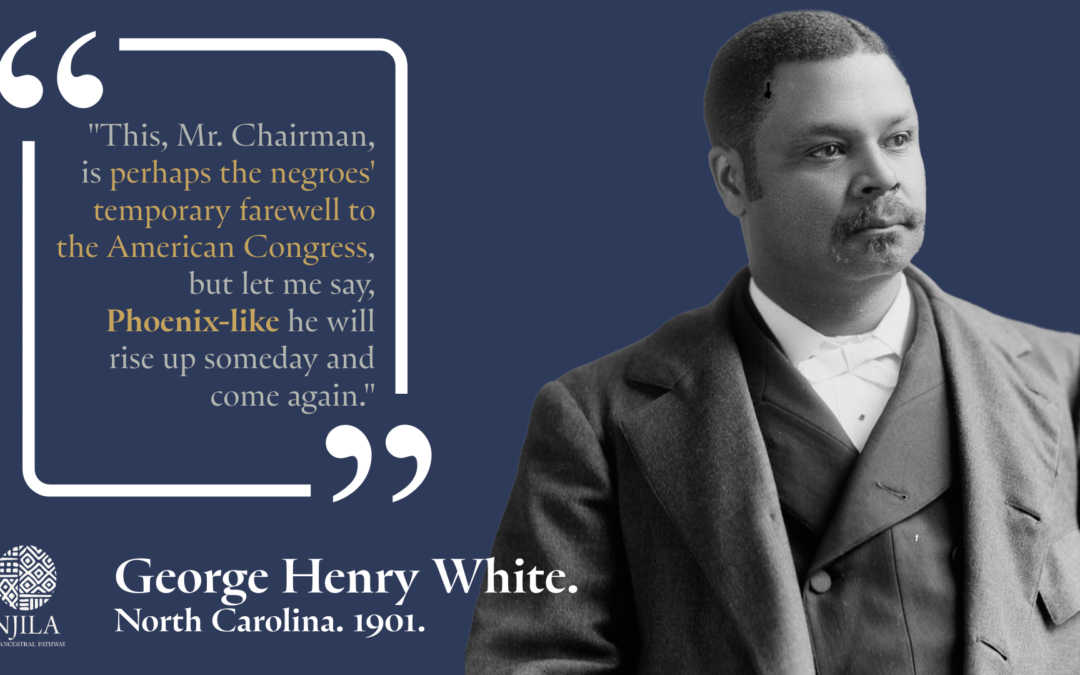
On January 29, 1901, George Henry White of North Carolina stood on the floor of the United States House of Representatives and delivered his farewell address. He was the last Black congressman from the South. He walked out on March 3, 1901. njila
Before he left, he made a promise.
"This, Mr. Chairman, is perhaps the negroes' temporary farewell to the American Congress, but let me say, Phoenix-like he will rise up someday and come again." njila
He was right. The Obama Presidential Center is opening today in Chicago.
The Silence Archive documents what happened between that farewell and this opening.
After the Civil War, more than 1,500 Black men held elected office across the American South. They served as governors, lieutenant governors, state treasurers, secretaries of state, state legislators, U.S. congressmen, and U.S. senators. They wrote constitutions. They built public schools. They held power. Then, state by state, they were removed — by assassination, by fraud, by law, and by organized violence. What followed was not a gradual decline. It was erasure. njila
No Black members of Congress came from the original eleven Confederate states from March 1901 until January 3, 1973 — 72 years of complete exclusion. Every Southern state. Every seat. For 72 years. njila
But 72 years is the collective figure. The individual state silences run longer. Alabama waited 116 years. Mississippi waited 104 years. Florida waited 117 years. njila
The silence did not happen by accident. It was built, state by state, by law and by violence, and sustained for seven decades. njila
The archive names the mechanisms: poll taxes, literacy tests, grandfather clauses, stolen elections, massacres. It counts the years. It names the officials who served before the silence, and the officials who broke it. The archive does not editorialize. It documents. It names. It counts. The numbers speak for themselves. njila
On January 3, 1973, Andrew Young of Georgia and Barbara Jordan of Texas were seated in the 93rd Congress. That is 72 years after George White's farewell. Young had been a senior aide to Martin Luther King Jr. Jordan had been the first Black woman elected to the Texas Senate. njila
Jordan's opening statement before the House Judiciary Committee during Watergate — "My faith in the Constitution is whole, it is complete, it is total" — is one of the most consequential speeches in the history of Congress. She broke a 72-year silence and then made the chamber remember what the document she was defending was supposed to mean. njila
They came in together. Two people. Two states. Nine states still had zero Black congressional representation when they arrived.
Today, the Obama Presidential Center opens in Chicago's Jackson Park, on a 20-acre campus blocks from Lake Michigan. Tomorrow it opens to the public. Tomorrow is Juneteenth. CBS News
The timing is not incidental. It is the kind of alignment the archive was built to document.
George Henry White was born enslaved in Bladen County, North Carolina in 1852. He introduced the first federal anti-lynching bill in 1900. It failed. He died in Philadelphia in 1918 — twelve years before another Black man entered Congress from anywhere, and 55 years before the South sent another. njila
He never saw the silence end. He never saw what his Phoenix speech was pointing toward.
The archive exists because the path remembers what the records forgot. What White saw in 1901 was not the end. It was a document of what was possible, filed in the body of a man who had already held power and knew it could be held again.
Every claim in this archive is sourced. Where a date or fact could not be confirmed through archival research, it is flagged and held until it can be. The archive does not publish what it cannot source. njila
What we can source today: there is a presidential center in Chicago. It is named for Barack Obama. It opens the day before Juneteenth.
He said Phoenix-like.
The archive confirms it.
B. Kelly | The Silence Archive is on view now at njila.org/the-silence-archive