I’ve been sitting with a list of names for two days now.
It’s a page from a poll book: Appomattox County, Virginia, District No. 5, October 1867. In a clerk’s handwriting, in a book kept for colored voters, is the name Robert Statham. Turn back three pages and there are the Isbells: Wyatt, Charles, James, Henry, Joseph, Edmond and Thomas.
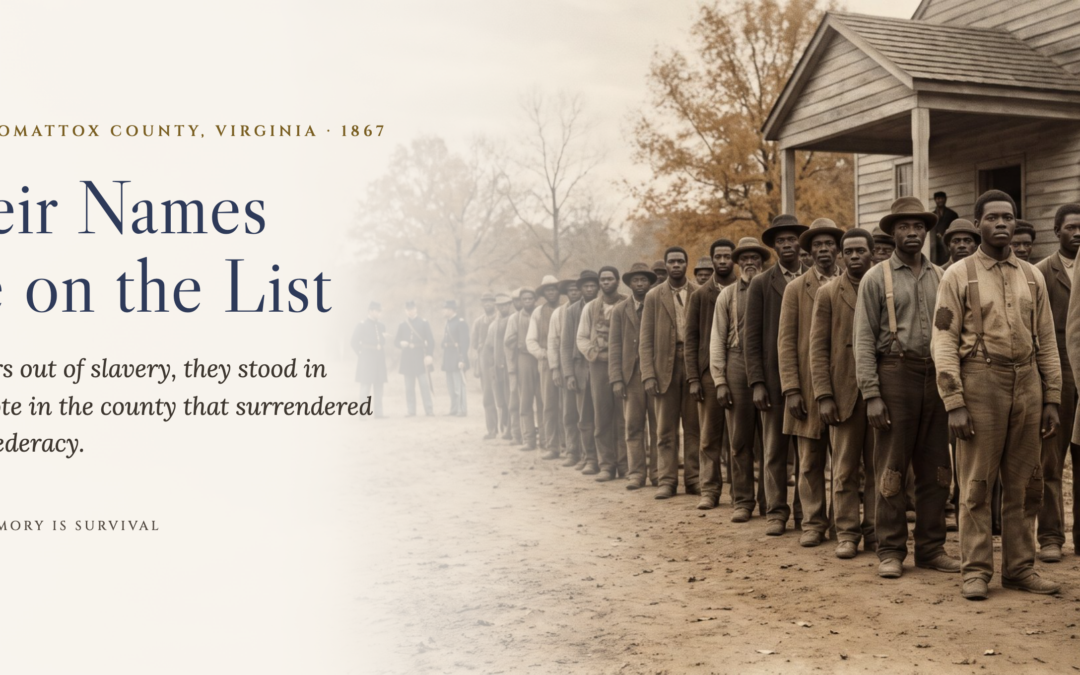
Two years before that page was written, these men were property. Appomattox is where the Confederacy surrendered, and it’s where they had been held. In October 1867 they walked to the polls in that same county and voted.
I’ve read a lot of records for this family. Census pages. Death certificates. An 1840 estate division that put a price on each human being, $300 here, $800 there. None of them stopped me the way this one did. It’s the first time I’ve seen the state write them down as citizens.
What I found
The 1867 poll books list the Black men who voted in Virginia’s first election open to them. It was held on October 22, 1867, under federal Reconstruction law, with U.S. Army officers keeping watch. White and colored voters had separate ballot boxes and separate books.
The Library of Virginia keeps these books, and you can see them free online through Virginia Untold. For so many of us, they’re the first place an ancestor who had been enslaved shows up with a first and last name.
The page itself is spare. A name, in rough alphabetical order. No age, no address, no word about who had owned him. Every man on it was at least 21, so each one was born before about 1846. That’s all it gives. It’s enough.
Robert and Bettie
Robert Statham and Bettie Isbell were both born into slavery in Virginia in the 1840s. By August 1870 they were keeping house in Clover Hill Township, Appomattox, with their daughters Laura, Phebe and Alice. Robert farmed. Bettie couldn’t read or write, which says less about her than about a system built to keep her from learning.
The Statham name came out of bondage too. In 1840 the estate of a Campbell County enslaver named Richmond Statham was divided among his children, and the people he held were split up right along with the land. I name him because the record has to be complete. He’s context. He is not kin.
Bettie lived until 1917. She gave birth to 15 children, and by 1910 only four of them were still living. I have to stop every time I write that sentence. She worked as a laundress and later as a nurse, and by 1900 her family owned their home outright. Her son Fletcher carried the family into the next century.
And here’s where I tell you exactly what I know and what I don’t, because that’s how we do this work:
- Robert. A “Statham Robert” is on the District 5 list. He’s the only Black Robert Statham on any 1867 list I’ve read for Appomattox, Campbell or Buckingham counties, and the men who lived right beside our Robert in 1870, the Prestons and Absalom Ransom, voted in that same district. I’m treating him as our Robert. I haven’t yet found the record that ties the two together by more than name and place.
- The Isbells. Wyatt, Charles and James carry the names of Bettie’s known Isbell kin, and a Wyatt Isbell was living in her district in 1880. A Henry Isbell voted too. Bettie’s death certificate names her father as Arthur, so where Henry fits is still an open question.
- Bettie. Bettie isn’t on the list. No woman is. She wouldn’t be allowed to vote for another 53 years.
What their votes did
The question on the ballot that day was whether Virginia would hold a convention to write a new constitution, and who would sit in it. More than 90,000 Black men voted across the state. They said yes, and they sent 24 Black delegates to that convention.
That convention wrote the Constitution of 1869. It protected Black men’s right to vote and created Virginia’s first public school system. Over the next twenty years, more than one hundred Black men served in the General Assembly. Robert and the Isbell men didn’t just live through that era. Their ballots helped open it.
I keep thinking about what it took. Two years out of slavery, standing in a public line, in a county full of the people who had held you, and saying out loud what kind of state you wanted to live in. Every name on that page is a choice somebody made.
Then the silence
It didn’t last. Black representation in the General Assembly was ground down through the 1880s by pressure and violence, and in 1902 Virginia rewrote its constitution to finish the job. A poll tax. An “understanding clause” that let a registrar decide whether you understood the constitution well enough to vote. The delegates said plainly that the point was to eliminate the Black vote. It worked. From 1890 until William Ferguson Reid took his seat on January 10, 1968, not one Black person served in the General Assembly. Seventy-eight years. We tell that whole story, name by name, on our Virginia page: The 78-Year Silence.
Here’s what those years look like inside my family:
- Bettie died in 1917, fifteen years under the 1902 constitution. She never cast a ballot.
- Fletcher, her son, was born around 1872, five years after his father’s name went into that poll book. He was about 30 when the 1902 constitution passed, and he died in 1952. His whole adult life ran inside the silence. He was gone sixteen years before Virginia seated another Black legislator.
- The women of the family got the vote on paper in 1920, and then met the same poll tax and the same registrar.
The silence wasn’t an accident, and it wasn’t just an absence. It was written down, on purpose, with the purpose stated on the record. When I lay the 1867 list next to the 1902 constitution, I see a family that was counted, and then deliberately uncounted.
Why I’m telling you this now
Election Day is November 3. I’m not going to tell you who to vote for. That’s yours. What I want you to know is what a ballot cost the people whose name my family carries.
Robert had been free about two years. He was a young farm laborer. He voted in Appomattox in 1867 with soldiers standing by, because everybody knew what could happen without them. And then the state spent most of the next century making sure his grandchildren couldn’t do what he did.
This isn’t ancient history. It’s the world our grandparents were born into, and some of the people who lived through it are still here to tell us about it. Ask them while you can.
I’m voting because Robert did, and because Bettie never got to.
Look for your own people. If your family was in Virginia in 1867, the poll books may be holding them. Search Virginia Untold at the Library of Virginia by county and district. A lot of the lists have a volunteer transcription next to the original, but read the original. Then read the names around your ancestor’s name. Those are the neighbors who stood in line with him.
Walk the map. Every church, school, lodge hall and cemetery that Black communities built during the silence is a monument to persistence without representation. More than 270 of those places, across 27 states and DC, are on the Black Heritage Map, each one verified in the archives. Find yours. And if you know a place that belongs there, tell us.
Read the whole archive. Virginia is one chapter. Every former Confederate state, six more states, Washington DC and the federal record are documented too. Start at The Silence Archive.